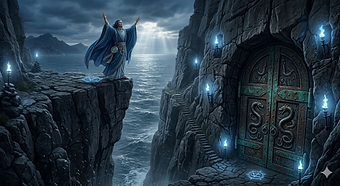
Project
TITANS’ PENTAD 巨神の五行
Merging Eastern Philosophy and Greek Mythology via BPM and Direction.
『第1柱 時を刻む道化師 TITANS’ PENTAD(巨神の五行)』
Pillar 1.Ticking Clown Titans’ Pentad
一度も振り返ったことはなかった。
I never once looked back.
気がついたら最後、巨大な気配に囚われると信じていた。
I believed that the moment I did, I would be ensnared by a colossal presence.
けれどもう言い訳は尽きた。今こそ振り返る時。
But excuses have run dry. Now is the time to turn around.
「踊っていたのか、踊らされていたのか。」
"Was I dancing, or was I being danced?"
【※本楽曲は、各部門一曲ずつからなる全五柱の組曲です。】
【Concept / コンセプト】
時・支配・円環をテーマにギリシャ神話の時の神「クロノス」をモチーフに、
爆笑問題・太田光氏の声を「不条理な円環(ループ)」の中に閉じ込めた
BPM120のミニマル・エレクトロです。調性はCmです。
Themed around Time, Dominance, and Cycles, this 120 BPM
minimal electro track is inspired by "Cronos," the Greek god of time. It traps
the voice of Hikari Ota (Bakusho Mondai) within an "absurd loop." Key: C Minor.
【Direction / 演出意図】
道化師のような陽気さと、剥き出しの批評性が共存する世界観を
「不気味なサーカス」として構築しました。
使用フレーズ「たすけてくれ」を、抗えないリズムの渦に配置することで、
喜劇と悲劇が表裏一体となった「時の支配」を表現しています。
扉が閉まる音で終わるラストは道化師自ら作り出した「時の支配」という檻の中に密閉されます。
Constructed as a "Eerie Circus" where clown-like cheerfulness coexists with raw criticism.
By placing the phrase "Help me" within an inescapable vortex of rhythm, it expresses
the "Dominance of Time" where comedy and tragedy are two sides of the same coin.
The final sound of a closing door seals the clown within the very cage of time he created.
『第2柱 西の境界と予言者 TITANS’ PENTAD(巨神の五行)』
Pillar 2. Prophet of the Western Border Titans’ Pentad
何から逃げていたのか、もう思い出せない。
I can no longer remember what I was running from.
自分の走っている道が、巨大な環(えん)を描いている。
The path I tread is drawing a massive circle.
立ち止まる事で得る事が必ずある。
There are things only gained by standing still.
「走っていたのか、走らされていたのか。」
"Was I running, or was I being run?"
【※本楽曲は、各部門一曲ずつからなる全五柱の組曲です。】
【Concept / コンセプト】
ギリシャ神話の巨神「イアペトス」をモチーフに、
ウエストランド(WESTLAND)という名が示す「西の端」の境界線を描いた、
BPM100の不気味な無機質エレクトロです。調性はGmです。
Inspired by the Titan "Iapetus," this 100 BPM inorganic electro track depicts
the boundary of the "West End" (as suggested by the name WESTLAND). Key: G Minor.
【Direction / 演出意図】
太陽が沈み、生と死が混ざり合う「世界の西端」に立つイアペトスを、
透明な糸で全てをそそのかす演者として定義しました。
使用フレーズ「変なのがどんどん世に出てきておそらく全員捕まる」「捕まりかけている」を、
出口のない迷宮のようなシーケンスに配置。
クワイアの非人間的な響きと、ワウによって執拗に揺らめく「蛇のうねり」のような音像が、
聴き手を逃げ場のない不条理な構造へと引き込みます。
Iapetus is defined as a performer standing at the "western edge of the world"
where sun sets and life blurs with death, manipulating everything with invisible threads.
The core phrases "Strange people are emerging one after another, and they'll probably all be caught" and
"They're on the verge of being caught" are embedded within a labyrinthine sequence with no exit.
The inhuman resonance of the choir and the "serpentine undulation"
of the wah-effect pull the listener into an inescapable, absurd structure.
【Acoustic Characteristics / 音響的特性】
一曲目「クロノス」の支配的な円環に対し、本作は「構造そのもの」を提示しています。
楽曲内で脈絡なく行き来するメジャーとマイナーの境界は、
捕まるか逃げ切るか、あるいは正気か狂気かといった、
ウエストランドの芸風の核心にある曖昧さや危うさを象徴的に表現しています
While the first pillar (Cronos) focuses on a dominant cycle, this work presents the "Structure" itself.
The seamless transition between major and minor scales symbolizes the ambiguity
and danger at the core of WESTLAND’s comedic style—the boundary between escape
and capture, sanity and madness.
『第3柱 深淵に潜む光の審判 TITANS’ PENTAD(巨神の五行)』
Pillar 3. The Judgement of Light Lurking in the Abyss Border Titans’ Pentad
囚われてしまったのは、自分の責任だ。
It is my own responsibility that I was captured.
ならば逆光を、力に変えよう。
Then, I shall turn this backlight into power.
その力は既にある。
That power already resides within me.
「消失は畏れであったのか、歓びであったのか。」
"Was disappearance a fear, or a joy?"
【※本楽曲は、各部門一曲ずつからなる全五柱の組曲です。】
【Concept / コンセプト】
ギリシャ神話の巨神「ヒュペリオン」をモチーフにした、
BPM110のアンビエント・エレクトロです。調性はE Lydianです。
「春とヒコーキ」という名が持つ、天をゆく浮遊感と、
すべてを照らす光のイメージをひとつの「構造」として構築しました。
A 110 BPM ambient electro track inspired
by the Titan "Hyperion." It constructs a single "Structure" based on the image
of floating through the heavens and the all-illuminating light
suggested by the name "Haru to Hikoki" (Spring and Airplane). Key: E Lydian.
【Direction / 演出意図】
二曲目「イアペトス」のBPM100(歩調)から、本作はBPM110へとわずかに加速します。
これは、高所に固定された光が自転し、周囲を「観測」していく周期を表現しています。
逃避の終わりと、光に包まれることによる救済を、一定のリズムの中で淡々と描きました。
The tempo accelerates slightly from Pillar 2’s 100 BPM (walking pace) to 110 BPM.
This represents the period of a light fixed at a high altitude as it rotates and "observes" its surroundings.
It portrays the end of escape and the salvation found in being enveloped by light.
【Acoustic Characteristics / 音響的特性】
シンセ・ストリングスによる感情を排した機械的なロングトーンに
「自転する天体が放つ光の干渉」のような浮実感を表現しました。
現代的なシンセ音に対し、あえて太古を思わせるコンガの響きをレイヤーしています。
これは、ヒュペリオンが光の源流であることを象徴し、
自転を支える根源的な鼓動(パルス)として機能します。
Mechanical long tones from synth strings express
the interference of light emitted by a rotating celestial body.
Ancient conga rhythms are layered over modern synth sounds,
symbolizing Hyperion as the primal source of light and acting as
the fundamental pulse supporting its rotation.
【Sublimation of Phrases / フレーズの昇華について】
本楽曲では、フレーズを「誠に誠です」と再解釈して配置しました。
緊張や葛藤の先にある言葉を、否定的な意味ではなく、存在そのものを全肯定する
「純粋な真実(誠)」として詩的・文学的フレーズとして昇華させました。
壮大なストリングスの音像とともに、
すべてが白く塗りつぶされるような光の終わりを感じていただければ幸いです。
In this track, the phrase was reinterpreted and positioned as "Makoto ni Makoto desu" (Truth of Truths).
I sublimated the words found beyond tension and conflict into a poetic
and literary phrase—not as something negative,
but as a "Pure Truth (Makoto)" that fully affirms existence itself.
Along with the grand soundscape of strings, I hope you feel the conclusion of light,
where everything is bleached into white.
『第4柱 知性と解き放たれた狂気 TITANS’ PENTAD(巨神の五行)』
Pillar 4. Intelligence the Mad Scientist Titans’ Pentad
鎖に繋がれている自身を、何度も顧みる。
I look back at myself, bound in chains, again and again.
そこに自分がいなかったから見出せなかった。
I could not find myself there, because I was not there.
自身の悦びが、自分の喜びとして他者へ拡がっていく。
My own pleasure expands toward others as my joy.
「巨大な気配が自身であったのか、自身が巨大な気配だったのか。」
"Was the colossal presence myself, or was I the colossal presence?"
【※本楽曲は、各部門一曲ずつからなる全五柱の組曲です。】
【Concept / コンセプト】
ギリシャ神話の知性の神「コイオス」をモチーフに、
ネコニスズが体現する不条理な実存を「知性の崩壊と人間への転落」として構築した
BPM120の狂気的ダークホラーアンビエントです。調性は A Locrianです。
A 120 BPM mad, dark-horror ambient track inspired by "Koios," the god of intellect.
It constructs the absurd existence embodied
by Nekonisuzu as a "collapse of intellect and a fall into humanity." Key: A Locrian.
【Direction / 演出意図】
囚われた知性の神が、自らの罪や審判から逃れるために選んだ究極の避難所――
それが「赤ちゃん(無垢)」への擬態です。
ピッチを下げた深淵の声から始まり、機械的なオルガンとウォーム系のシンセが、
凍りついた知性の迷宮を描き出します。
本楽曲の核心は、自己の内側から響く「可愛くないからダメですよ」という
否定の声(内なる天使の囁き)と内なる断罪練習の果てにたどり着いた
究極の「可愛さ」と言う人間化。
The captive god of intellect chooses the ultimate refuge to escape
his sins and judgment: mimicking an "Infant (Innocence).
" Starting with deep, pitch-shifted voices from the abyss,
mechanical organs and warm synths depict a frozen labyrinth of intellect.
The core of this track is the "humanization" of cuteness reached through self-negation and inner condemnation—the whispering of an "inner angel" saying, "You’re not cute, so you’re no good."
知性は自己の否定を克服しようと、
狂ったように「赤ちゃんです」というフレーズを反復練習します。
ピッチが上がり続け、理想の無垢へと近づこうともがきます。
しかし、過剰な練習(執念)は逆に知性を剥ぎ取り、
最後には完璧な擬態を維持できなくなった「生身の人間(ネコニスズ)」の声が漏れ出します。
「どれほど知性を駆使して自己を偽ろうとも、最後に残るのは剥き出しの人間である」という、
本連作における最も残酷で誠実な一節です。
In an attempt to overcome self-denial, the intellect obsessively practices
the phrase "I am a baby." The pitch continues to rise as it struggles to reach a state of ideal innocence.
However, this excessive practice (obsession) instead strips away the intellect, and ultimately,
the voice of a "raw human (Nekonisuzu)" leaks out, unable to maintain the perfect mimicry.
It is the most cruel yet sincere passage in this series:
"No matter how much intellect one uses to disguise oneself,
what remains in the end is the exposed human being."
『第5柱 遊牧と巡る世界 TITANS’ PENTAD(巨神の五行)』
Pillar 5. Around the world Titans’ Pentad
檻だと思わされていた事には驚愕した。
I was astonished to learn that what I thought was a cage was not.
華が開き育ち枯れ落ち、また花が咲く。
Flowers bloom, grow, wither, and bloom again.
それが最大の抱擁であったことに気づく。
I realize that this was the ultimate embrace.
「始まりが終わりか、終わりが始まりか。」
"Is the beginning the end, or the end the beginning?"
―彼らは誇りを取り戻したのだ。
—They have reclaimed their pride.
大地を踏みしめ、開かれた扉へと消えていく。
Treading firmly upon the earth, they vanish into the opened door.
その足音だけを残して。
Leaving only their footsteps behind...
【※本楽曲は、各部門一曲ずつからなる全五柱の組曲です。】
【Concept / コンセプト】
ギリシャ神話の巨神「クレイオス」をモチーフに、
脳みそ夫氏の声を「歴史の公転と宇宙の裏側」を繋ぐ座標として配置した
デジタル・フォークロアです。調性は D Mixolydianです。
A digital folklore track inspired by the Titan "Crius," positioning the voice of
Nou-Misoo as coordinates connecting "the revolution of history" and "the back of the universe.
" Key: D Mixolydian.
【Direction / 演出意図】
楽曲冒頭には、脳みそ夫氏のギャグ「小さな乱」を可視化された
一輪の「小さな蘭(花)」として配置しました。
「小さな蘭」という、ちっぽけな存在から始まり、
隋の時代から現代、そして未来へと続く円環を「晴・曇・雨」の気象変化として描きます。
「晴れ(子供)→曇り(大人)→雨(老人)」という三段階の気象変化を、
生命の公転として描き出しています。
使用フレーズ「おったま遣隋使」は構造を理解した驚愕を、
「やだ、胸キュン隋使」は全てをリセットし、
再び草原の始まり(蕾)へと回帰させる愛着のスイッチとして機能します。
At the beginning of the track, the gag "Chiisana Ran" (Small Rebellion)
by Nou-Misoo is visualized and positioned as a single "Small Orchid (Ran).
" Starting from this tiny existence, the cycle stretching from the Sui Dynasty to
the present and into the future is depicted through
weather changes: "Sunny, Cloudy, and Rainy.
" This three-stage transition—"Sunny (Child) → Cloudy (Adult) → Rainy (Elder)"
—is portrayed as the revolution of life.
The phrase "Ottama-Kenzuishi" functions as the shock of understanding the structure,
while "Yada, Munekyun-Zuishi" acts as an attachment switch that resets everything
and returns to the beginning of the meadow (the bud).
【Acoustic Characteristics / 音響的特性】
BPM120の厳格なグリッドの上に、3連符を基調としたリズムを配置。
これにより、他の4柱(4つ打ち主体)とは一線を画す、
独特の「酩酊感」と「放浪感」を生み出します。
Dミクソリディアン特有の「どこにも辿り着かない浮遊感」と相まって、
リスナーを異次元へと誘います。
楽曲内で表現される「晴・曇・雨」の気象変化は、メロディの変化によって具体化しています。
「晴れ」の場面ではコンガのみが鳴り響き、「曇り」ではベースと最小限のバスドラムが加わり、「雨」の場面でベースとドラムが完全に揃います。
これは、生命の循環を楽器編成の変遷で描く試みです。
The 120 BPM grid with triplet rhythms creates a sense of "intoxication"
and "wandering," distinct from the other four pillars (which are primarily four-on-the-floor).
Combined with the distinctive, floating sensation of D Mixolydian,
it invites the listener into another dimension.
The weather changes of "Sunny, Cloudy, and Rainy" are materialized through shifts in melody.
In the "Sunny" scenes, only the congas resonate;
in "Cloudy," the bass and a minimal bass drum are added;
and in "Rainy," the bass and drums are fully synchronized.
This is an attempt to depict the cycle of life through the transition of instrumentation.
【最後に / Epilogue】
太古の神話を構成する上で全曲バラ打ちのドラムトラック、音色を極限まで削ぎ落としています。
In constructing this ancient myth, I have stripped back the soundscape to its barest essentials,
utilizing individually programmed drum tracks for every song.
全五柱の頭文字が描く調性(Key)の符合「C-G-E-A-D」は、
並び替える事により幽閉された巨神の檻(CAGED)を意味します。
そして、もう一度並びを替えると「CDEGA」と言う
C MAJOR PENTATONIC SCALEとなり自由で根源的を意味します。
The keys of the five pillars—C, G, E, A, and D—can be rearranged to spell "CAGED,"
representing the prison of the captive Titans.
Rearranging them once more yields the C MAJOR PENTATONIC SCALE (C-D-E-G-A),
symbolizing primal freedom.
本曲のBPM 120は中心・北・南を繋ぐ「360度の円環」を完成させる封印として作用。
東が110、西が100という朝(1)夜(0)を意味し、
5曲合わせて570と言う数字は5+7+0=12はタイタン12神をも感じさせる構造としています。
The 120 BPM acts as a seal completing a "360-degree circle" connecting the Center, North, and South. With the East at 110 and West at 100 representing Morning (1) and Night (0), the total of 570 from the five tracks (5+7+0=12) creates a structure that evokes the Twelve Titans.
この楽曲は、
Audiostock主催の「タイタン芸人フレーズ作曲コンテスト」への挑戦から生まれました。
巨神たちの魂を揺さぶる機会をくれたこのコンテストに、最大の敬意を。
This track was born from the "Titan Comedian Phrase Music Contest" hosted by Audiostock.
Maximum respect to this contest for giving me the chance to stir the souls of the Titans.
https://audiostock.jp/special/titan
【Bonus track】
『第6柱 万物を統べる静寂の潮流 TITANS’ PENTAD(巨神の五行)』
Pillar 6. Battle with TITAN Titans’ Pentad